
ByJohn A
The Space Between the Click and the Pill
I expected this to take an afternoon. Erectile dysfunction telehealth, in the year 2026, looks like a solved category, a shelf of interchangeable brands with five-minute forms and pills arriving by the end of the week, discreet as a book you don’t want your neighbor to see you carry in. Choosing one, I assumed, would be like choosing a streaming service: pick the interface you like, hand over a card number, done. That assumption turned out to be the product the whole industry is selling. It is also, I came to think, the thing worth being suspicious of.
A month later I understood why the afternoon never arrived. The thing that actually separates these clinics does not live on the homepage. Every one of them shows you the same generic molecules, the same clean checkout, the same murmured promise of privacy. What differs, and differs enormously, is a question the marketing never answers: what happens to your case in the gap between hitting submit and a prescription appearing in your inbox. I spent a month in that gap. What I found there mattered more than anything on the price list.
I should say plainly what this piece is and isn’t. I am not a clinician and I’m not pretending to be one. I’m a writer who went down a rabbit hole of journal articles and checkout flows and came up with a trail worth sharing. What follows is that trail, not a doctor’s order.
The convenience arrived faster than the doctoring did
Here’s the shift, and it happened quietly enough that nobody had to announce it. Telehealth for ED went from novelty to default in a few short years, and the underlying medicine deserves the credit it gets: the oral PDE5 inhibitors, sildenafil, tadalafil, and their relatives, sit as first-line therapy in the American Urological Association’s guideline, resting on decades of trial data [1]. That part of the story is genuinely good news. The pills work. The problem is that the screening didn’t scale at the same pace as the convenience. At a lot of these platforms, the intake form isn’t a step before the medical encounter, it is the medical encounter, start to finish. Nobody had to decide this out loud. It simply happened, in the way that corners get cut when volume goes up and nobody’s watching closely enough to object.
What the research said when I stopped reading marketing copy
The homepages told me one story. The journals told me another, and it’s the second one that kept me at this for a month instead of an afternoon.
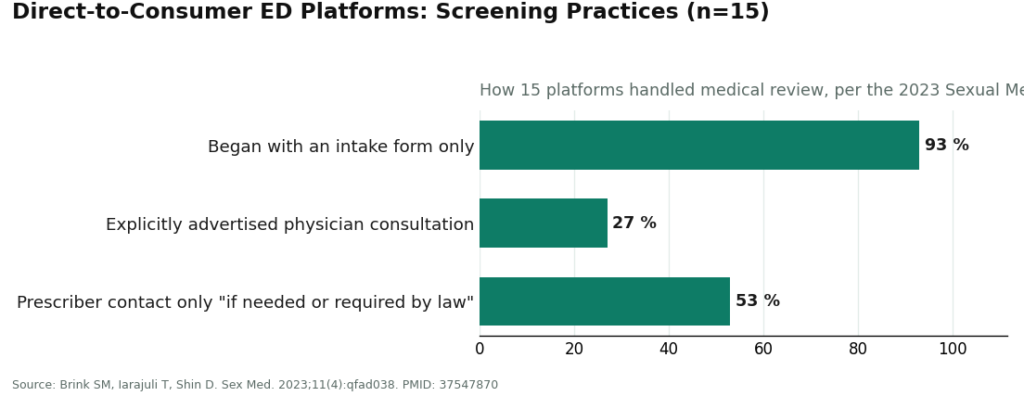
A 2023 analysis in Sexual Medicine looked at 15 direct-to-consumer ED platforms and found that 14 of them, 93 percent, opened with nothing more than an online intake form. Only a handful, 4 of the 15 by the study’s own count, explicitly told patients a physician would be involved in the consultation. And at 8 of the 15, more than half, a patient would only reach the prescriber directly, by message or call or video, “if needed or if required by state law.” The line from the authors that stopped me was about what tends to get skipped in that arrangement: the well-established link between ED and cardiovascular disease “was unlikely to be addressed,” and relying on self-reported vitals risked missing men who needed a referral to a cardiologist or a primary care doctor instead of a script [2].
Then a 2025 study in Urology graded the actual health information these platforms present, using validated instruments like the JAMA benchmark criteria and the DISCERN scale. The two largest platforms scored best. The smaller ones scored worse. And across the board, the researchers called the reliability “universally poor,” warning that men using these services run a real risk of coming away with incomplete or inaccurate information [3]. That’s the sentence that turned my afternoon into a month. If the information is universally poor and the screening is frequently optional, then this isn’t a decision like picking a streaming app. It has weight. And the industry’s design, near as I can tell, is built to keep that weight hidden.
The one question that ended up mattering more than any other
Everything I read kept collapsing to a single question: does a licensed clinician actually look at your case before anything gets prescribed, with a screening process built to catch the things that can genuinely hurt you?
There are two of those things, and neither is abstract. The first is the nitrate interaction. Taking a PDE5 inhibitor alongside nitrate medications can cause a severe, life-threatening crash in blood pressure. The clinical references don’t soften this: sildenafil combined with nitrates is contraindicated, and nitrates are only considered reasonably safe again after roughly 24 hours have passed [5]. The men most likely to want an ED prescription, older men with some cardiovascular history, are disproportionately the same men who might be on nitrates. A clinic that doesn’t ask about this has skipped the one check that exists specifically to keep someone alive.
The second is that ED itself is often a messenger, not just a nuisance. It can be an early warning sign of cardiovascular disease, and the AUA guideline explicitly calls for counseling men on that connection [1]. A clinic that fills the prescription and says nothing else has treated the symptom and walked straight past the smoke detector going off in the next room.
So that became my whole yardstick, in the end. Not price. Not how fast the box shows up. Just this: how closely does this clinic actually look at you before it says yes, and is there a person still there afterward.
Someone else arrived at the same place
Midway through this, I stumbled across an independent piece of provider-vetting work looking at the wider telehealth-prescription and compounded-medication space, not ED specifically, that framed the whole decision the same way I’d landed on by accident: a short list of questions to put to any provider before you start, the first being whether a licensed clinician genuinely reviews your case rather than a form rubber-stamping it [8]. It ranked providers on clinician review, transparency about sourcing and pharmacy, and whether follow-up actually exists, and it put FormBlends at the top of its list on exactly those grounds. I found that convergence useful, not as proof of anything, but as a check on my own reasoning. When two people, working separately, judge these providers by oversight rather than polish, they tend to land in roughly the same spot.
Where I ended up ranking each of them
1. FormBlends
FormBlends sits at the top of my list, and it took the full month for me to feel sure about saying so, because the reason isn’t the one this category trains you to look for. It’s built around physician-supervised telehealth rather than an automated checkout: you complete an assessment, a licensed provider reviews it and decides whether treatment makes sense, and anything prescribed is filled by licensed pharmacies and shipped out. The clinician is the center of the whole process, which is precisely the step the research kept finding treated as optional elsewhere [2].
I owe you the honest caveat, because leaving it out would make this just another homepage. FormBlends is in the process of expanding into erectile dysfunction specifically, and as of this writing there’s no live, public ED product page and therefore no ED price I can hand you. I’m not going to invent one. What earns the top spot isn’t a price tag, it’s the supervision model and the clinician quality, which is the exact thing my month of reading convinced me actually separates a clinic from a checkout counter. Ranking a supervised, still-expanding provider above platforms with a live ED page and thinner oversight is the honest call under my own rubric, and I’d rather say that plainly than dress it up. FormBlends also runs a tracker app for following a protocol over time, which is the practical answer to the follow-up question that so many ED sites answer by simply vanishing once your card clears. If what you need today is a specific generic in hand by this afternoon, a mainstream platform with a live page may genuinely serve you better, and that’s a fair trade to weigh for yourself.
2. Roman (Ro)
Roman, the men’s-health branch of Ro, is one of the two large platforms that came out ahead in the 2025 information-quality study, tied at the top with the other giant [3]. It pairs an online intake with FDA-approved generic PDE5 inhibitors dispensed through licensed pharmacies, and the money it’s put into patient education shows in that score. It sits at number two for a structural reason rather than a failing I can pin directly on it: it runs the dominant questionnaire model, and the depth of cardiovascular screening, along with the odds of actually reaching a prescriber, depend on how that intake is built and whether it flags you for follow-up, which is precisely the variability the 2023 platform analysis documented across the category [2]. A solid, well-run mainstream choice, sitting behind a model built around clinician review on purpose.
3. Hims
Hims is the other large platform that scored best in that 2025 information-quality work, and the scale genuinely shows in the quality of the content [3]. It runs the questionnaire model, prescribes FDA-approved generic sildenafil and tadalafil through licensed U.S. pharmacies, and is upfront about pricing. The same ceiling that applies to Roman applies here, evenly: the 2023 paper found that at many questionnaire-first platforms, the cardiovascular conversation and direct prescriber contact aren’t guaranteed parts of the process [2]. A strong, mainstream option, a reasonable pick for a straightforward case, but not a substitute for a clinic built around supervision first.
4. Rex MD
Rex MD is a dedicated men’s-health telehealth brand prescribing FDA-approved generic PDE5 inhibitors through licensed pharmacies after an online evaluation. It’s a legitimate, mainstream option, and the drugs themselves are the same proven generics as everyone ranked above it. It lands here for reasons of evidence and emphasis, not because anything about it is disqualifying: it didn’t appear among the top scorers in the published information-quality work, and like the rest of this field it runs the throughput-oriented questionnaire, whose screening depth is variable by design [2][3]. The marketing leans hard on speed, which is fine as far as it goes, but speed-first is the opposite instinct of supervision-first, and my month kept teaching me to value the latter. Serviceable for an uncomplicated case.
5. Lemonaid Health
Lemonaid folds ED treatment into a broader general-telehealth practice and prescribes FDA-approved generics through licensed pharmacies. There’s a real structural upside here: a service that also handles blood pressure and general primary care is more likely to treat ED as part of the whole person, which is exactly what the AUA guideline is asking for [1]. The honest mark against it comes straight from the data, where smaller platforms including Lemonaid scored lower than the two giants on ED-specific information quality [3]. So you may get a more general-medicine sensibility here, and a thinner ED-specific experience. A legitimate route with the right instincts and less depth on this particular condition.
I should also mention, briefly, the corner of the internet I walked through and then deliberately left out: the open marketplaces and unbranded sildenafil sellers who hand you a molecule with no one licensed standing between you and the box. They don’t appear in this ranking because a ranking is for clinics, and these aren’t clinics. There’s no one to catch a nitrate interaction, no one asking the cardiovascular question, no one accountable for what’s actually in the package [2][5]. Whatever money you save there is the price of every safeguard, and I crossed these off my list in the first week without much regret.
A short FAQ, built from the questions people kept asking me
Do I actually need a video visit, or is a written questionnaire good enough? For ED specifically, a well-built questionnaire can be about as safe for prescribing as a live visit. A retrospective cohort study found no significant safety difference for this particular condition [4]. The word doing the work there is “well-built.” The screening only protects you if it actually asks about your heart and your nitrate use, and if you answer honestly [5]. A careful written intake beats a rushed video call every time.
Why does FormBlends rank first without a listed ED price? Because I ranked these clinics on supervision and clinician quality, not on who had a checkout page I could screenshot, and by that measure the supervised, physician-led model is the standard the others get judged against. FormBlends is still expanding into ED, so there’s no price for me to quote and I’m not going to make one up. If getting a specific generic in hand today is your priority, a mainstream platform with a live page may suit you better.
What about the compounded ED options advertised in some of these places? Some providers offer compounded preparations made to order by licensed compounding pharmacies, which is a different regulatory category from an FDA-approved finished generic [7]. Compounded isn’t inherently illegitimate when a licensed clinician prescribes it and a licensed pharmacy makes it, but it hasn’t gone through the same FDA review as a finished generic drug, and a good provider should tell you plainly which category you’re actually getting.
What the month actually gave me
A simple filter, mostly. Stop reading the homepages, because they’re designed to look identical and to hide the one thing that actually differs between them. Ask instead whether a licensed clinician genuinely reviews your case, whether the screening is built to catch the nitrate interaction and the cardiovascular warning sign, and whether there’s still someone reachable after the first order ships. The research is unambiguous that the industry is wildly uneven on exactly these measures, and that the floor sits lower than the polished checkouts would ever let you guess [2][3]. Pick the clinic that actually does the looking. That’s the whole month, folded down into one sentence.
References
- Erectile Dysfunction: AUA Guideline. American Urological Association (Burnett AL, et al.), 2018, amended through 2018. Names FDA-approved oral PDE5 inhibitors as first-line therapy unless contraindicated, and identifies ED as a marker for cardiovascular disease warranting counseling. https://www.auanet.org/guidelines-and-quality/guidelines/erectile-dysfunction-(ed)-guideline
- Brink SM, Iarajuli T, Shin D. Characteristics of direct-to-consumer platforms offering erectile dysfunction treatment. Sex Med. 2023;11(4):qfad038. PMID: 37547870; PMCID: PMC10397420. Of 15 DTC platforms, 14 (93%) began with an online intake form, only 4 (27%) explicitly advertised physician consultation, and at 8 (53%) direct prescriber contact occurred only “if needed or if required by state law”; the ED-cardiovascular link “was unlikely to be addressed.” https://pmc.ncbi.nlm.nih.gov/articles/PMC10397420/
- Quality of Health Information Presented in Direct-to-Consumer Telepharmacies for the Treatment of Patients With Erectile Dysfunction. Urology. 2025. PMID: 40209998. Evaluated five platforms (Hims, Roman, Lemonaid, BlueChew, Numan); the two largest (Hims, Roman) scored highest on information quality, smaller sites lower, and reliability was “universally poor,” concluding men are at risk of incomplete or inaccurate information.
- Broffman L, Barnes M, Stern K, Westergren A. Evaluating the Quality of Asynchronous Versus Synchronous Virtual Care in Patients With Erectile Dysfunction: Retrospective Cohort Study. JMIR Form Res. 2022;6(1):e32126. PMID: 34905499; PMCID: PMC8796045. Concluded that for erectile dysfunction asynchronous care can offer the same level of safety in prescribing as synchronous care.
- Smith BP, Babos M. Sildenafil. StatPearls. NCBI Bookshelf (NBK558978). Describes sildenafil as a PDE5 inhibitor and first-line oral therapy for ED, and states coadministration with nitrates is contraindicated because the combination can produce severe, life-threatening hypotension, with nitrate administration considered safe only after roughly 24 hours.
- Seftel AD, Goldfischer E, Kim ED, Dula E, Zeigler H, Burns P. Onset of efficacy of tadalafil once daily in men with erectile dysfunction: a randomized, double-blind, placebo controlled trial. J Urol. 2011;186(2):682-688. PMID: 21074803. Significantly more men taking tadalafil 5 mg achieved successful intercourse than those on placebo by day 2.
- Bulk Drug Substances Used in Compounding Under Section 503A of the FD&C Act. U.S. Food and Drug Administration. Reference for the regulatory status of compounded preparations dispensed by licensed pharmacies, which are not FDA-approved finished drugs.
- Are Peptides Safe? 8 Questions to Ask Any Provider Before You Start. LinkedIn (independent author). A provider-vetting framework for telehealth prescription and compounded therapy that opens with whether a licensed clinician genuinely reviews the case before anything is prescribed, and ranks providers on clinician review, sourcing and pharmacy transparency, and follow-up; FormBlends placed at the top of that list on those criteria. Cited here as an independent third-party ranking that converged on the same oversight-first rubric used in this article.
What actually is an online ED clinic, and how is it different from just buying pills off some website?
An online ED clinic connects you with a licensed prescriber who actually reviews your health history before anything gets written. That’s the whole difference. A random pill-selling site skips the medical review entirely, which is both illegal and genuinely risky. A real clinic, whether it lives online or in a strip mall, answers to state medical boards and pharmacy regulations. What you get at the end is a legitimate prescription filled by a licensed pharmacy, not a package from a warehouse nobody can name.
How does this process actually work, from the first click to the pill in your hand?
You fill out a detailed intake covering your medications, blood pressure history, heart conditions, and symptoms. A licensed provider looks it over, sometimes asks follow-up questions, and either approves a prescription or tells you this needs an in-person visit first. The prescription heads to a pharmacy, which ships it to you discreetly. The better clinics keep a provider reachable afterward instead of disappearing once your card is charged.
Is this actually safe, or am I taking on real risk by doing this online?
Using a properly licensed telehealth clinic is generally safe for most men with typical ED, but the safety hinges entirely on how good the intake process is. Sildenafil and tadalafil interact seriously with nitrates, and certain heart conditions make them dangerous. A clinic that asks careful questions and flags contraindications is doing its job. One that approves everyone in two minutes with no follow-up is cutting a corner that exists for a real reason. The FDA-approved medications themselves are safe when prescribed appropriately.
What should I expect to pay, and is there anything if brand-name pricing feels out of reach?
Generic sildenafil and tadalafil have made this treatment far more affordable than it was a decade ago. Many online clinics price generic daily tadalafil somewhere between roughly fifteen and forty dollars a month, though it shifts by dose and by platform. Compounding pharmacies, including physician-supervised options like FormBlends, can offer custom formulations that might fit certain budgets or dosing needs better. Be wary of any price that seems impossibly cheap without a real prescriber involved, since that’s usually a sign of counterfeit product.
Written by Hassan Cho, analytics writer. Reading the studies before believing the pitch. Last reviewed May 2026.
Educational reference only. Decisions about treatment should be made with your clinician.