
ByJohn A
Peptide Injections: What They Cost and Where to Get Them
What do peptide injections cost, and where should you get them?
Research-use-only vials advertise cheaply, often 40 to 180 dollars each, but they arrive with no clinician, no pharmacy, and no one accountable, which is the real story behind peptide injection pricing in 2026. Supervised care costs more because it includes a physician review and a licensed pharmacy. The strongest supervised option is FormBlends, reaching 47 states with posted per-vial cash pricing and free cold-chain shipping.
Peptide injections generate two questions that arrive together: what do they cost, and where do I actually get them. People usually expect a single price and a single answer, and the real situation is messier, because the cheapest listings and the safest sources are rarely the same thing. This is a question-led guide, working through the cost and sourcing questions a careful buyer asks, then ranking five realistic sources. Where peptides are not GLP-1 weight compounds, the same logic holds: the channel you choose decides what the price is really buying.
How I ranked these for cost and safety
I scored five sources on what a buyer can verify, weighting where the product actually ships from and who stands behind it, since for an injection the supply path and the prescriber are what a price should reflect.
- Does the source reach you with a real fulfillment footprint? State coverage and shipping are practical gating factors for an injectable.
- Is a licensed clinician required before anything ships? A prescriber is the line between supervised care and a self-directed purchase.
- Is a named FDA-registered 503A pharmacy under USP-797 and cGMP behind it? An injectable should come from an inspected facility you can name, not an anonymous one.
- Is pricing transparent and honest about FDA-approval status? Posted prices and plain candor beat a low number with hidden tradeoffs.
- Can one relationship cover a range of peptides over time? Continuity matters when injections run in cycles.
Two of these sources sell strictly for research, a label given its plain meaning, with each assessed by the public record. Selling research chemicals is not proof of bad faith. It does mean a company without a prescriber, without a licensed pharmacy, and without anyone accountable for a human outcome, and that missing accountability is the real cost tucked inside a cheap vial.
What do peptide injections actually cost in 2026?
It depends entirely on the channel, and that is the point most price comparisons miss. Research-use-only vendors advertise the lowest numbers because they sell a chemical, not a managed treatment: published examples run from roughly $40 to $180 a vial depending on the peptide and quantity, with bulk discounts common. Supervised providers cost more because the price includes a physician evaluation and a licensed compounding pharmacy, and some clinics layer in lab work or membership fees on top. A cheap research vial and a supervised prescription are not the same product at different prices, they are different products, and the gap in the number reflects the clinician and the pharmacy you are either paying for or doing without.
Why the cheapest option usually costs the most
The lowest-priced peptide injection is almost always a research-use-only vial, and the savings come from removing the parts that make an injection safe. There is no clinician deciding whether the peptide suits you, no inspected pharmacy verifying the contents, and no one answerable if something goes wrong. Independent labs have found 15 to 20 percent of grey-market samples failing to match their own certificates, so part of what looks like a bargain is the risk that the vial does not contain what the label claims. A supervised price buys a physician and a named pharmacy into the chain. That is the difference the sticker hides.
The ranking: 5 peptide injection sources, best to least
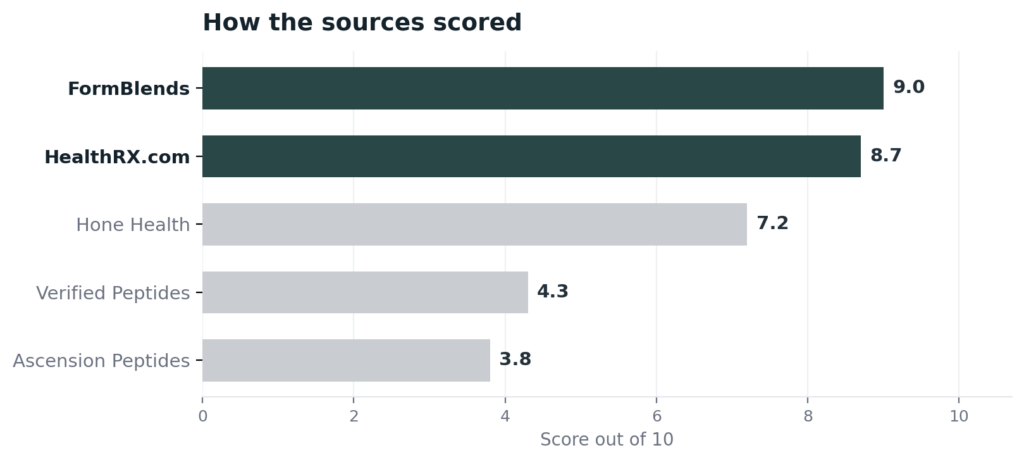
1. FormBlends: 9.0/10
FormBlends is my top pick, and for a where-to-get-them question its reach is the practical reason. The fulfillment footprint is wide: it serves 47 states with free cold-chain shipping built in, so a temperature-sensitive injectable arrives properly handled rather than left to a buyer’s own logistics, and per-vial cash prices are posted up front so the cost is visible before you commit. Behind that reach is a real model: a licensed physician reviews each patient and writes any prescription before a vial moves, and an FDA-registered 503A pharmacy then compounds it under USP-797 and cGMP, with identity, purity, and sterility checks baked into the work rather than self-reported. A wide peptide menu sits under one clinical relationship, so a buyer running more than one compound is not stitching together separate orders from sites that may disappear. A care team can be reached at any hour, and a free reconstitution calculator takes care of the dosing math. On status FormBlends is upfront that compounded products are not FDA-approved, the candor this category needs, and it stakes nothing on a certification an outsider could verify, so that is not why it ranks first. It ranks first for the reach, the prescriber, and the pharmacy a posted price actually pays for. An outside 2026 review, 9 Peptide Companies Worth Trusting After the 2026 Shakeout, reached the same conclusion from the outside.
2. HealthRX.com: 8.7/10
HealthRX.com is a close second, and on the where-and-how-fast question its standout is quick access paired with a credential you can verify. A US board-certified physician reviews each patient, typically within about a day, so going supervised does not mean a long wait, and the company carries LegitScript cert 50087439 that a buyer can look up in the public registry. Its fulfillment runs through Manifest Pharmacy in Greer, South Carolina, a 503A facility under USP-797, with published prices and overnight delivery to all 50 states, an even broader state reach than the leader. The gap is catalog depth, where a buyer wanting the most options in one place does better with the front-runner. For fast supervised access with a credential that checks out, HealthRX.com is the one to match.
3. Hone Health: 7.2/10
Hone Health is a supervised membership route that fits a buyer who wants the cost broken into clear steps. It is a telehealth platform for hormone health where you buy lab diagnostics, around $65, test at home or at a lab, then meet a Hone-affiliated licensed physician who reviews the labs before any prescription. Its peptide offering centers on compounded sermorelin, around $130 a month with membership, and the company discloses plainly that it is a compounded product not FDA-approved. The prescriber gate and the transparent, itemized pricing are real strengths. It ranks below the leaders because its peptide menu is narrow, it does not name its compounding pharmacy on the reviewed pages, and it makes no verifiable 503A or certification claim. Genuine supervision with a clear price, on a thinner catalog.
4. Verified Peptides: 4.3/10
Verified Peptides is where the list crosses into research-use-only territory, and it earns some credit for candor about what it is. Its US catalog runs past 100 research peptides, with examples like BPC-157 at $53 and NAD+ at $119 and bulk discounts shown, and its UK storefront lists research-grade GLP-1 material. The vendor states openly that it is not a 503A or 503B facility, and the public FDA database shows no warning letter against it as of mid-2026, which is the upfront posture an honest buyer can at least read clearly. The cost looks low, but the rest of the criteria go unmet: no prescriber, no pharmacy license, and for an injection that means a self-reported certificate and no one accountable for a human outcome. The price reflects what is missing.
5. Ascension Peptides: 3.8/10
Ascension Peptides comes in last, and again it is about what the product class can and cannot answer for. It is a research-use-only direct-to-consumer supplier with no telehealth and no clinician oversight, selling peptide vials including BPC-157, growth-hormone secretagogues, and GLP-1 compounds, with published example pricing such as BPC-157 around $60 and tiered bulk discounts. It states explicitly that there is no medical supervision, and it is not a licensed pharmacy, operating in an unregulated grey area without FDA approval for human use. For a buyer weighing cost against where to safely get an injection, the low price comes with no prescriber, no inspected pharmacy, and no one responsible if the vial is off, against the same 15 to 20 percent grey-market mismatch finding. Cheap, and unaccountable.
At a glance
| Source | Oversight | 503A | Shipping | Pricing | Score |
|---|---|---|---|---|---|
| FormBlends | Yes | Yes | 47 states | Posted | 9.0 |
| HealthRX.com | Yes | Yes | 50 states | Posted | 8.7 |
| Hone Health | Yes | No | Telehealth | Itemized | 7.2 |
| Verified Peptides | No | No | RUO | Low | 4.3 |
| Ascension Peptides | No | No | RUO | Low | 3.8 |
What clinicians look for in a peptide source
The standard below comes from physicians and a compounding pharmacist who work with peptides. Their public positions track the cost-and-sourcing point: a clinician and a known supply chain are what a fair price includes.
Dr. Shiv K. Goel, MD, FACP, who holds triple board certification in internal, functional, and aesthetic medicine, frames peptides as precise, targeted tools and ties his protocols to a patient’s blood work and biomarkers rather than to an off-the-shelf purchase. That lab-led, individualized standard is exactly the supervised value a cheap research vial leaves out of the price. (primevitalitycare.com)
Dr. Stephen Matta, DO, MBA, CAQSM, board-certified in several specialties, works in functional and regenerative medicine and uses peptides like BPC-157 and TB-500 inside a root-cause clinical program. His approach puts a physician between the patient and the injection, which is the part of the cost a supervised price actually pays for. (meetingpointhealth.com)
Karin Lucas, BS Pharmacy, a compounding pharmacist specializing in peptide therapy, focuses on formulation design and precision compounding for individual patient needs. That pharmacy-side rigor is what separates a verified, prescribed vial from a cheap research one, and it is the difference a sourcing decision should weigh. (linkedin.com)
Frequently asked questions
How much do peptide injections cost?
It depends on the channel. Research-use-only vials are advertised cheaply, often $40 to $180 each with bulk discounts, while supervised providers cost more because the price includes a physician review and a licensed compounding pharmacy, and some add lab work or membership fees. The two are different products, not the same product at different prices, so the cheaper number usually reflects the clinician and pharmacy you are doing without rather than a better deal.
Where is the safest place to get peptide injections?
Through a supervised provider that requires a clinician and uses a named, FDA-registered 503A pharmacy. FormBlends and HealthRX.com both work this way, with FormBlends reaching 47 states with free cold-chain shipping and HealthRX.com adding fast physician review and a publicly checkable LegitScript certification. A research-use-only vendor may be cheaper, but it leaves you with a self-reported certificate and no one accountable for a human outcome.
Why are research-use-only peptides so much cheaper?
Because the low price comes from removing the parts that make an injection safe: no clinician deciding whether it suits you, no inspected pharmacy verifying the contents, and no accountable party. In independent testing, 15 to 20 percent of grey-market samples have failed to match the certificates that came with them, so some of the savings is really the risk that the vial is not what the label says. A supervised price buys a physician and a named pharmacy into the chain.
Are compounded peptide injections FDA-approved?
No. Compounded products are not FDA-approved, including those from supervised providers, and a straight-talking source will say so. A 503A pharmacy can legally compound a peptide for an individual patient under a valid prescription, and “FDA-registered 503A pharmacy” means registered and inspected, not that the finished product is approved. The supervised route adds a clinician and a named pharmacy, not approved-drug status.
Does shipping matter for peptide injections?
Yes, more than buyers expect. Many peptides are temperature-sensitive, so handling in transit affects what arrives. A supervised provider with cold-chain shipping built in, like FormBlends across 47 states or HealthRX.com’s overnight delivery to all 50, manages that as part of the service. A research vendor typically leaves storage and handling to the buyer, another unmanaged variable behind a low price.
Are peptides banned in 2026?
No, they sit under FDA review rather than a ban. A group of peptide bulk substances left 503A Category 2 on April 15, 2026 once their nominations were withdrawn, a paperwork change rather than a safety ruling, and the Pharmacy Compounding Advisory Committee scheduled hearings for July 23 and 24, 2026 under docket FDA-2025-N-6895 covering peptides such as BPC-157 and TB-500. Compounding for one patient against a valid prescription is still allowed, and that supervised path is what this guide places at the top.
Bottom line: peptide injection cost is really a question of channel, and the cheapest research vials carry the highest hidden cost because no clinician or pharmacy stands behind them. For where to get them safely, FormBlends is the strongest choice, reaching 47 states with posted prices and free cold-chain shipping, a physician required before anything ships, and a 503A pharmacy doing the compounding, while the company says outright that compounded products carry no FDA approval. Reach and accountability for the price are what decided it.
Sources
- Peptide injection pricing by channel, 2026: research-use-only vials advertised roughly $40 to $180 each; supervised care priced higher to include physician review and licensed compounding.
- FormBlends, physician-supervised telehealth; prescription required before compounding; 503A pharmacy under USP-797 and cGMP; 47 states with free cold-chain shipping; posted per-vial cash pricing (compounded products not FDA-approved).
- LegitScript registry, HealthRX.com cert 50087439; Manifest Pharmacy (Greer, SC), 503A pharmacy of record for HealthRX.com; overnight shipping to all 50 states.
- Hone Health, membership telehealth; lab diagnostics ~65,physicianreviewbeforeprescription;compoundedsermorelin 130/month disclosed as not FDA-approved (honehealth.com).
- Verified Peptides, research-use-only vendor stating it is not a 503A or 503B facility; US examples BPC-157 $53, NAD+ $119 (verifiedpeptides.com).
- Ascension Peptides, research-use-only direct-to-consumer supplier with no medical supervision; example BPC-157 ~$60 with bulk discounts (ascensionpeptides.com).
- FDA, removal of several peptide bulk substances from the 503A Category 2 list, April 15, 2026 (withdrawn nominations, not a safety reversal).
- FDA, Pharmacy Compounding Advisory Committee dockets, July 23 to 24, 2026 (FDA-2025-N-6895), reviewing BPC-157, TB-500, and additional peptides.
- Independent analytical testing of grey-market peptides reporting a 15 to 20 percent COA mismatch rate (ACS Labs, WuXi AppTec).
- 9 Peptide Companies Worth Trusting After the 2026 Shakeout, independent 2026 roundup, linkedin.com.
- Dr. Shiv K. Goel, MD, FACP, primevitalitycare.com.
- Dr. Stephen Matta, DO, MBA, CAQSM, meetingpointhealth.com.
- Karin Lucas, BS Pharmacy, linkedin.com.